
Many Eyes: A Site for Social Data Analysis
MIT Building 2, Room 105 182 Memorial Drive, Cambridge, MAIBM's Visual Communication Lab recently launched Many Eyes, a website devoted to a new social style of data analysis and visualization.

MIT Graduate Program in Comparative Media Studies
Studying Media and Making Media
IBM's Visual Communication Lab recently launched Many Eyes, a website devoted to a new social style of data analysis and visualization.

Papermint's success is based on its practical realisation of Barbara Lippe's research on Japanese gaming and girl culture.

Alan Moore, co-author of Communities Dominate Brands, believes that community-based engagement initiatives will replace the traditional media orthodoxies.

Jim Ross, the longtime voice of World Wrestling Entertainment, joins CMS graduate student Sam Ford to discuss the unique blend of reality and fiction in the world of American professional wrestling.

Today evangelical groups are active in all media, from the Internet and cellular telephones to print journalism, broadcasting, film, and multi-media entertainment
This year's MIT European Short Film Festival topics are New Identities/Social Realities, Transformations, Mitteleuropa/Central Europe.

Matthew Weise is an MIT/Comparative Media Studies alum who has been working since his 2004 graduation in the mobile games industry.
Our ability to understand and be interested in the compositions at the extremes has kept pace.
The Media Spectacle showcases films, videos, video podcasts, and mobisodes produced by MIT (and Wellesley) affiliates, staff, students and faculty.

Our understanding of the technical and social processes by which culture is made and reproduced is being challenged and enlarged by digital technologies.

Longtime soap opera writer Kay Alden will talk with about her decades in the industry with CMS graduate student Sam Ford.
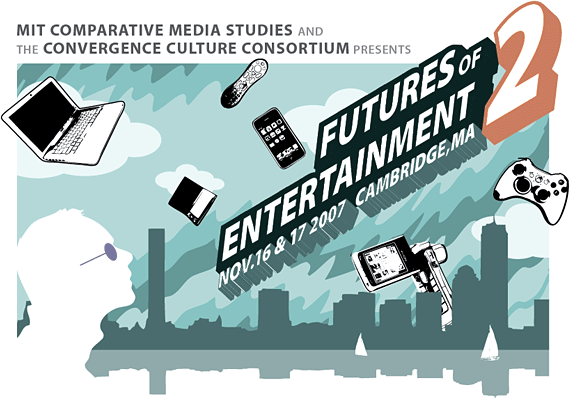
Developments in advertising, cult media, metrics, measurement, and accounting for audiences, cultural labor and audience relations.

Members of Comparative Media Studies' GAMBIT Research Staff will deliver from 2-3PM each day a different videogame-based lecture.

An account of Czech underground rock music of the 60s, 70s and 80s when rock music was considered suspicious and counterrevolutionary.

